Showing posts with label Animation. Show all posts

Saturday, June 19, 2010

Fritz the Cat

The Inimitable Fritz the cat from the sixties cult cartoon character by Robert Crumb.

A hypocritical swinging college student cat raises hell in a satiric vision of various elements of the 1960's.
A persiflage on the protest movements of the 60s. It's hero is the bold and sex-obsessed tom-cat Fritz the Cat, as created by the legendary underground artist Robert Crumb. Quitting university Fritz the Cat wanders through the hash, Black Panther and Hell's Angels scenes to find to himself.

Fritz the Cat is a 1972 American animated film written and directed by Ralph Bakshi as his feature film debut. Based on the comic strip of the same name by Robert Crumb, the film was the first animated feature film to receive an X rating in the United States. It focuses on Fritz (voiced by Skip Hinnant), an anthropomorphic feline in mid-1960s New York City who explores the ideals of hedonism and sociopolitical consciousness. The film is a satire focusing on American college life of the era, race relations, the free love movement, and left- and right-wing politics. Fritz the Cat was the most successful independent animated feature of all time, grossing over $100 million worldwide.

Fritz the Cat had a troubled production history and controversial release. Creator Robert Crumb is known to have had disagreements with the filmmakers, claiming in interviews that his first wife signed over the film rights to the characters, and that he did not approve the production. Crumb was also critical of the film's approach to his material. Fritz the Cat was controversial for its rating and content, which viewers at the time found to be offensive. Its success led to a slew of other X-rated animated films, and a sequel, The Nine Lives of Fritz the Cat, was made without Crumb's or Bakshi's involvement.


In a New York park, hippies have gathered with guitars to sing protest songs. Fritz and his friends show up in an attempt to meet girls. When a trio of attractive females walk by, Fritz and his friends exhaust themselves trying to get their attention, but find that the girls are more interested in the crow standing a few feet away. The girls attempt to flirt with the crow, making unintentionally condescending remarks about black people, while Fritz looks on in annoyance. Suddenly, the crow rebukes the girls with a snide remark and walks away. Fritz tries to pick up the girls by convincing them that he is a tormented soul, and invites them to "seek the truth", bringing them up to his friend's apartment, where a wild party is taking place. Since the other rooms are crowded, Fritz drags the girls into the bathroom and the four of them have group sex in the bathtub. Meanwhile, the police (portrayed as pigs) arrive to raid the party. As the two officers walk up the stairs, one of the partygoers finds Fritz and the girls in the bath tub. Several others jump in, pushing Fritz to the side where he takes solace in marijuana. The two officers break into the apartment, but find that it is empty because everyone has moved into the bathroom. Fritz takes refuge in the toilet when one of the pigs enters the bathroom and begins to beat up the partygoers. As the pig becomes exhausted, a very intoxicated Fritz jumps out, grabs the pig's gun, and shoots the toilet, causing the water main to break and flooding everybody out of the apartment. The pigs chase Fritz down the street into a synagogue. Fritz manages to escape when the congregation gets up to celebrate the United States' decision to send more weapons into Israel.

Fritz the Cat (1972) (Sub)The Nine Lives of Fritz the CatThe Life & Death of Fritz the CatFritz the Cat (1972) (Sub)The Nine Lives of Fritz the Cat

Fritz makes it back to his dormitory, where his roommates ignore him. He sets all of his notes and books on fire. The fire spreads throughout the dorm, finally setting the entire building ablaze. In a bar in Harlem, Fritz meets Duke the Crow at a billiard table. After narrowly avoiding getting into a fight with the bartender, Duke invites Fritz to "bug out". When Duke steals a car, Fritz is eager to join the illegal activity. Following a wild ride, Fritz drives the car off a bridge. Before the car crashes into the water and rocks below, Duke saves Fritz's life. The two arrive at an apartment owned by Bertha, a crow and former prostitute turned drug dealer. When Fritz arrives, she shoves several joints into his mouth. The marijuana increases his libido, so he rushes off into an alley to have sex with Bertha. While having sex, he comes to a supreme realization that he "must tell the people about the revolution!" He runs off into the city street and incites a riot, during which Duke is shot and killed, and Fritz is chased by several cops.

Fritz hides in an alley where his fox girlfriend, Winston Schwartz, finds him. She drags him on a road trip to San Francisco. On the road, she stops at a Howard Johnson's restaurant, and disenchants Fritz by her refusal to go to unusual places. When the car runs out of gas in the middle of the desert, Fritz decides to abandon her. Fritz meets up with Blue, a heroin-addicted rabbit biker. Along with Blue's horse girlfriend, Harriet, they take a ride to an underground hide-out where several other revolutionaries tell Fritz of their plan to blow up a power station. When Harriet tries to get Blue to leave, he hits her several times and ties her down with a chain. When Fritz objects to their treatment of her, he is hit in the face with a candle by the group's leader, a lizard. The group throws Harriet onto a bed and rapes her. In the next scene, Harriet is sitting in a graveyard, naked and traumatized. Fritz puts a coat over her and gets into a car with the leader to drive out to the power plant. After setting the dynamite, Fritz suddenly has a change of heart. The lizard lights the fuse and drives off as Fritz tries to get the dynamite out of its tight spot and fails. The dynamite explodes, blowing up both the power plant and Fritz. At a Los Angeles hospital, Harriet (now a nun) and the girls from the New York park come to comfort him. It is in this scene that, as John Grant writes in his book Masters of Animation, Fritz realizes that he should "stick to his original hedonist philosophy and let the rest of the world take care of itself."[1] In the final moments of the film, the audience sees Fritz have sexual intercourse with the girls from the park again.

The Nine Lives of Fritz the Cat (R) (1974)


Imdb Link - Fritz the Cat (1972)

Friday, May 7, 2010

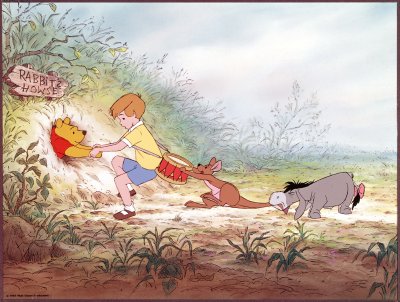
The Many Adventures of Winnie The Pooh

Winnie the Pooh needs no Introduction - the many adventures of Winnie the Pooh was a movie i looked forward to as a child because i had already got to know him well from the books.I think everyone has to love Winnie, Tigger and Co.


Pooh, a bear of very little brain, and all his friends in the Hundred Acre Wood sing their way through adventures that encompass honey, bees, bouncing, balloons, Eeyore's birthday, floods, and Pooh sticks.

he Many Adventures of Winnie the Pooh is the 22nd full-length animated film produced by Walt Disney Productions and first released on March 11, 1977.

The film is actually composed of material from three previously released animated featurettes based upon the Winnie-the-Pooh books by A. A. Milne: Winnie the Pooh and the Honey Tree (1966), Winnie the Pooh and the Blustery Day (1968), and Winnie the Pooh and Tigger Too! (1974). Because of this, it is seen by some as the last of the Disney "package films" (movies consisting of two or more short segments), the bulk of which were produced by the studio to keep costs down during World War II. Pooh was produced for similar economic reasons. This is also the last film in the Disney canon in which Walt Disney had personal involvement, since one of the shorts (Winnie the Pooh and the Honey Tree) was released during his lifetime, and he was involved in the production of Blustery Day. A fourth and final featurette based on the original books, Winnie the Pooh and a Day for Eeyore, was released in 1983 and is included as a bonus feature on the VHS and DVD release of the feature film.

Its characters have spawned an industry of sequels, television programs, clothing, books, and toys. The film differs from the three individual shorts by having newly-created linking material, and an ending to give closure to the stories (based on the final chapter of The House at Pooh Corner). It was always Walt Disney's intention to create a feature film, but he decided to make shorts instead — after production had begun — to familiarize US audiences with the characters. All three shorts as well as future feature films boast classic songs by the Sherman Brothers including "Winnie The Pooh" and "The Wonderful Thing About Tiggers".

The film also inspired an attraction of the same name at Disneyland, Walt Disney World, and Hong Kong Disneyland. A much more elaborate attraction, also based on the film, opened in Tokyo Disneyland as "Pooh's Hunny Hunt".

Links; official winnie the pooh site
Reblog this post [with Zemanta]

Wednesday, January 20, 2010

Dumbo (1941)


Dumbo is a 1941 American animated film produced by Walt Disney and released on October 23, 1941, by RKO Radio Pictures. he fourth film in the Walt Disney Animated Classics series, Dumbo is based upon a child's book of the same name by Helen Aberson and illustrated by Harold Pearl. The main character is Jumbo Jr., a semi-anthropomorphic elephant who is cruelly nicknamed Dumbo. He is ridiculed for his big ears, but in fact he is capable of flying by using his ears as wings. Throughout most of the film, his only true friend, aside from his mother, is the mouse, Timothy; a relationship parodying the stereotypical animosity between mice and elephants.

Despite the advent of World War II, Dumbo was still the most financially successful Disney film of the 1940s. This was one of the first of Disney's animated films to be broadcast, albeit severely edited, on television, as part of Disney's anthology series. The film then received another distinction of note in 1981, when it was the first of Disney's canon of animated films to be released on home video.

The Lion King (Disney Special Platinum Edition)  Sleeping Beauty (Two-Disc Platinum Edition) Hercules (Disney Gold Classic Collection) Beauty and the Beast (Special Platinum Edition) The Unofficial Guide Walt Disney World 2010 (Unofficial Guides)


Watch Disney's Animated Classic; Dumbo


Dumbo was made to recoup the financial losses of Fantasia. The film has been criticized as being racist (the leader crow in the film is named "Jim Crow"), yet is also considered to be one of Disney's finest films. It was a deliberate pursuit of simplicity and economy for the Disney studio, and is now generally regarded as a classic of animation. At 64 minutes, it is one of Disney's shortest animated features.


Plot Synopsis;


While circus animals are being transported, Mrs. Jumbo, one of the elephants, receives her baby from a stork. The baby elephant is quickly taunted by the other elephants because of his large ears, and they nickname him "Dumbo".

Once the circus is set up, Mrs. Jumbo loses her temper at a group of children for making fun of her son, and she is locked up and deemed mad. Dumbo is shunned by the other elephants and with no mother to care for him, he is now alone, except for a self-appointed mentor and protector, Timothy Q. Mouse, who feels sympathy for Dumbo and becomes determined to make him happy again.

The circus director makes Dumbo the top of an elephant pyramid stunt, but Dumbo causes the stunt to go wrong, injuring the other elephants and bringing down the big top. Dumbo is made a clown as a result, and plays the main role in an act that involves him falling into a vat of pie filling. Despite his newfound popularity and fame, Dumbo hates this job and is now more miserable than ever.

To cheer Dumbo up, Timothy takes him to visit his mother. On the way back Dumbo cries and then starts to hiccup so Timothy decides to take him for a drink of water from a bucket which, unknown to him, has accidentally had a bottle of champagne knocked into it. As a result, Dumbo and Timothy both become drunk and see hallucinations of pink elephants.

The next morning, Dumbo and Timothy wake up in a tree. Timothy wonders how they got up in the tree, and concludes that Dumbo flew up there using his large ears as wings. With the help of a group of crows, Timothy is able to get Dumbo to fly again, using a psychological trick of a "magic feather" to boost his confidence.

Back at the circus, Dumbo must perform his stunt of jumping from a high building, this time from a much higher platform. On the way down, Dumbo loses the feather and Timothy tells him that the feather was never magical, and that he is still able to fly. Dumbo is able to pull out of the dive and flies around the circus.

After this performance, Dumbo becomes a media sensation, Timothy becomes his manager, and Dumbo and Mrs. Jumbo are given a private car on the circus train.

The Adventures of Ichabod and Mr. Toad (Disney Gold Classic Collection)  Fantasia (film): Animation, Walt Disney, Walt Disney Animated Classics, Classical music, Dialogue, Composer, Leopold Stokowski, Philadelphia Orchestra, ... Avant- garde, Stereophonic sound, Fantasound Melody Time (Disney Gold Classic Collection) Tinkerbell Peter Pan Walt Disney Animated Movie Character Classic Metal Retro Style Lunchbox Snow White and the Seven Dwarfs

The film was designed as an economical feature to help generate income for the Disney studio after the financial failures of both Pinocchio and Fantasia in 1940. Storymen Dick Huemer and Joe Grant were the primary figures in developing the plot, based upon a children's book written by Helen Aberson and illustrated by Harold Pearl (the only involvement the authors had with the cartoon industry). Their book was made of only 8 drawings and just a few lines of text. When it was published in 1939, the edition was so small and obscure that nobody knows how Disney got his hands on it. He gave it to his lead animators and told them to see what they could get out of it.

 Aladdin (Disney Special Platinum Edition) The Jungle Book (40th Anniversary Platinum Edition) The Little Mermaid (Two-Disc Platinum Edition)  The Hidden Magic of Walt Disney World: Over 600 Secrets of the Magic Kingdom, Epcot, Disney's Hollywood Studios, and Animal Kingdom Alice in Wonderland (Masterpiece Edition)

When the film went into production in early 1941, supervising director Ben Sharpsteen was given orders to keep the film simple and inexpensive. As a result, Dumbo lacks the lavish detail of the previous three Disney animated features (Fantasia, Pinocchio, and Snow White and the Seven Dwarfs): character designs are simpler, background paintings are less detailed, and a number of held cels (or frames) were used in the character animation.

Controversy

The crow characters in the film are seen as African-American stereotypes. The leader crow was originally named "Jim Crow" for script purposes, and the name stuck. The other crows are all voiced by African-American actors, all members of the Hall Johnson Choir. Despite suggestions of racism by critics such as Richard Schickel, many historians such as Zoe Pritchard reject these claims. For instance, the crows are noted as forming the majority of the characters in the movie who are sympathetic to Dumbo's plight (the others are Timothy Q. Mouse and Mrs. Jumbo), are free spirits who serve nobody, and intelligent characters aware of the power of self-confidence, unlike the Stepin Fetchit stereotype common at that time. Furthermore, their song "When I See An Elephant Fly," which uses intricate wordplay in the lyrics, is more oriented to mocking Timothy Mouse than Dumbo's large ears.


Reblog this post [with Zemanta]

E-Mail Subscriptions

Enter your email address:

Delivered by FeedBurner

All Movie Categories

Dramas Comedies Romantic Movies Adventure Movies Family Movies Warner Brothers Metro Goldwyn Mayer Musicals Silverscreen War Movies Paramount Pictures United Artists Action Childrens' Movies Historical Movies Columbia Pictures Humphrey Bogart RKO Thrillers Crime Cary Grant Cult Movies Disney Westerns Fantasy Film Noir 1953 1955 Tony Curtis 1954 Animation Billy Wilder Christmas Specials Greta Garbo Jack Lemmon James Mason John Wayne Movie Wallpapers Peter Lorre Tarzan Movies 1946 1951 1956 1958 1959 1961 1967 20th Century Fox ABC Blake Edwards Gregory Peck Mickey Rooney Universal Pictures 1932 1937 1938 1939 1944 1949 Anthony Quinn Argosy Pictures Audrey Hepburn Ben Johnson Charles Bronson David Niven Dean Martin Delmer Daves Grace Kelly Intrigue James Stewart Romance Sad Movies William Holden 1936 1940 1941 1942 1948 1960 1963 1964 1977 1980 Angie Dickinson Burt Reynolds David O. Selznick Deborah Kerr Dennis O'Keefe Detective Movies Elvis Presley Ernst Lubitsch Henry Fonda Herbert Lom Ingrid Bergman Jack Nicholson James Cagney Jerry Lewis John Ford Johnny Weissmuller Judy Garland Katharine Hepburn Kirk Douglas Lauren Bacall Leslie Howard London Film Productions Marlene Dietrich Natalie Wood Peter Sellers Peter Ustinov Robert Strauss Romans Sally Field Science Fiction Stanley Kramer Steve McQueen Virginia Mayo Walter Matthau William Wyler 1915 1930 1931 1933 1934 1943 1945 1947 1957 1965 1966 1968 1969 1970 1971 1972 1975 1976 1978 1985 1986 1987 ATP Alan Parker Anjelica Huston Anne Rutherford Anthony Quayle Arthur Wontner Basil Rathbone Bela Lugosi Biblical Movies Cesar Romero Charles Laughton Charlotte Rampling Charlton Heston Christopher Lee Christopher Plummer Clark Gable Claude Rains Danny Kaye Darrel F.Zanuck David Bowie Dennis Hopper Dick Van Dyke Donald Pleasance Edmond O'Brien Elizabeth Taylor Elke Sommer First Artists Frank Sinatra Gary Cooper George Bancroft George Peppard George Raft Graham Cutts Greer Garson Horror Movies Howard Hawks Howard Hughes Howard Keel Ian Hunter Ida Lupino Jacques Tourneur James Coburn James Garner JamesMason Jim Henson John Gilbert John Travolta Josef von Sternberg Julie Christie Kathleen Turner Laurence Olivier Lee Marvin Lillian Gish Lionel Barrymore Lloyd Bridges Lon Chaney Jr. Margaret Landon Marilyn Monroe Mark Robson Maureen O'Sullivan Micheal redgrave Mickey Rourke Neil Simon Nigel Bruce Olivia de Havilland Peter Falk Peter Fonda Political Ralph Bakshi Ramon Novarro Raoul Walsh Raymond Massey Richard Attenborough Richard Burton Richard Harris Ricky Nelson Rita Moreno Robert DeNiro Robert Mitchum Robert Taylor Robert Wise Sammy Davis Jr. Shelley Winters Shirley MacClaine Shirley Temple Sidney Poitier Sony Pictures Sophia Loren Susan Hayward Trevor Howard Tri Star Pictures Vivien Leigh Walter Lang Warren Beatty Yul Brynner